
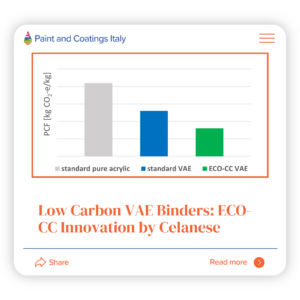
The European Union has set climate targets to reduce greenhouse gas (GHG) emissions. Industries like paints and coatings (P&C) are actively seeking solutions.
Scope 3 emissions include all indirect GHG emissions across a company’s value chain. These emissions are major contributors to a company’s carbon impact. Raw materials usually account for the largest share of product carbon footprints (PCF). Thus, turning to materials with lower carbon intensity is key.
Celanese CCU technology in the spotlight
To help customers meet their targets in lowering their scope 3 emissions and in offering products with a significantly lower PCF, Celanese has established a portfolio of vinyl acetate – ethylene (VAE) copolymer binders made with CO2 emissions. This is being achieved by utilizing Celanese’s large-scale carbon capture and utilization (CCU) operations which started early 2024 at our site in Clear Lake, TX and annually captures up to 180.000 metric tons of CO2 waste emissions to produce around 130.000 metric tons of building block chemicals. This technology produces materials that feed into our Acetyl value chain to create vinyl acetate monomer, which we then convert into VAE dispersions. These polymer dispersions serve as key raw materials in architectural interior and exterior paints, waterborne lacquers as well as in plasters and other building and construction solutions.

ECO-CC – Product offerings using CCU technology
Celanese offers its ECO-CC emulsion polymers, developed with CCU technology, based on a mass-balancing approach.Therefore maintaining the emission and cost benefits of large scale and highly optimized manufacturing processes whilst also avoiding the necessity to re-qualify the lower-PCF products at paint producers as they pose real drop-in solutions for our well-established fossil-based VAE binders.
The paints formulated with our ECO-CC binders maintain the technical benefits that our standard VAE products are well known for, like
- easy-to-formulate / coalescent agent-free formulations
- low VOC levels (volatile organic compounds)
- APEO-free
- excellent hiding power and color retention
- high wet-scrub resistance
- beneficial blocking resistance in semi-gloss paints
By using CO2 as a circular feedstock via CCU technology, our ECO-CC products are delivering the following key improvements as compared to standard fossil-based binders:
🌳 a significant reduction of the PCF of the products and
🌳 a substantial share of circular content

Don’t miss the opportunity to explore these topics in depth and discover the latest innovations in the industry. Register for Paint & Coatings Italy to access exclusive content like this and much more.
To learn more about this subject, don’t miss Celanese’s presentation at the Construction Chemicals Academy at Paint & Coatings Italy on 9th of October at 10:00.